How To Measure Oven Temperature With A Thermometer
Measuring oven temperature with a thermometer is the simplest way to ensure your food cooks evenly and safely. Many ovens run hotter or colder than their dial suggests, which can ruin recipes and affect baking results. This guide walks you through choosing, placing, and calibrating the right thermometer for accurate oven temperature readings every time.
Measuring oven temperature with a thermometer might sound like a small detail, but it changes everything about how your food turns out. If you have ever wondered why your cookies burn on the edges but stay raw in the middle, the answer might be your oven’s temperature. Most ovens have a built-in dial or display that tells you what heat setting you are using. But here is the truth: that reading is often wrong. Studies show that many home ovens can be off by 25 to 50 degrees Fahrenheit. That is a huge gap when you are trying to bake a perfect cake or roast a chicken to the right internal temperature.
Using a dedicated oven thermometer solves this problem instantly. It gives you a real, honest look at what is actually happening inside your oven. Whether you are a beginner baker or a seasoned home cook, knowing your true oven temperature helps you get consistent results every single time. This guide covers everything you need to know, from the different types of thermometers to where to place them and how to calibrate for accuracy.
The good news is that measuring oven temperature is easy, affordable, and takes only a few minutes. You do not need fancy equipment or technical skills. A basic oven thermometer costs just a few dollars and can save you from wasted ingredients, failed bakes, and a lot of frustration. Let us walk through the process step by step so you can trust your oven’s heat every time you cook.
By the end of this guide, you will understand why oven temperature accuracy matters, which type of thermometer works best for you, and exactly how to test and calibrate your oven. You will also learn about common problems like hot spots and temperature fluctuations, and how to fix them. Let us get started.
Key Takeaways
- Use an oven thermometer: Your oven’s built-in dial can be off by 25°F or more, making an external thermometer essential for accurate oven temperature measurement.
- Choose the right type: Analog and digital thermometers each have benefits, so pick based on your baking needs and budget.
- Placement matters: Center rack placement gives the most reliable readings for even heat distribution across the oven cavity.
- Calibrate regularly: A quick calibration test takes minutes and ensures your oven temperature stays accurate over time.
- Watch for hot spots: Rotating pans and knowing your oven’s cold zones leads to noticeably better baking results.
- Check before every bake: Ovens drift over time, so make temperature testing a regular part of your cooking routine.
📑 Table of Contents
- Why Measuring Oven Temperature Matters
- Types of Oven Thermometers Available
- How to Place Your Oven Thermometer Correctly
- Step-by-Step: Testing and Calibrating Your Oven
- Common Oven Temperature Problems and Solutions
- Tips for Consistent Baking and Cooking Results
- Final Thoughts on How To Measure Oven Temperature
Why Measuring Oven Temperature Matters
Most people assume their oven heats to exactly the temperature they set. But that is rarely the case. The oven thermostat inside your appliance can drift over time due to regular use, wear, and age. This means your oven might be running hotter or cooler than what the dial says. And even a small difference can have a big impact on your cooking.
When you measure oven temperature accurately, you take control of your cooking. You stop guessing and start knowing. This is especially important for baking, where precision matters a lot. A cake baked at the wrong temperature can rise unevenly, turn dense, or burn on the outside while staying gooey inside. Roasting meat also depends heavily on accurate heat. A roast that sits in a too-cool oven for too long can dry out or fail to reach a safe food safety temperature.
How Oven Temperature Affects Your Food
Heat drives every chemical reaction in cooking. When you bake, the baking temperature determines how quickly gluten forms, how leavening agents react, and how moisture evaporates. Too much heat and the outside burns before the inside cooks. Too little heat and your food takes forever to cook, or it never reaches the right texture at all.
For roasting, accurate heat ensures meat cooks evenly from edge to center. It also helps create a beautiful golden-brown crust through the Maillard reaction, which only happens at the right temperature range. If your oven runs cold, you lose that desirable browning. If it runs hot, you risk charring the exterior while the interior stays undercooked.
Here are a few ways inaccurate oven temperature can affect your results:
- Baked goods rise unevenly or collapse because the heat is not consistent.
- Cookies spread too much or stay too thick depending on whether the oven is too hot or too cool.
- Meat cooks unevenly, with some parts overdone and others underdone.
- Bread crusts burn while the crumb inside remains raw.
- Energy waste occurs because you end up cooking longer to compensate for low heat.
The bottom line is simple. If you care about your cooking, you need to know the real temperature inside your oven. A thermometer is the only way to find out for sure.
Types of Oven Thermometers Available
Not all thermometers are the same. There are several options available, and each one has its own strengths. Understanding the differences helps you pick the right one for your kitchen and cooking style.
Analog Oven Thermometers
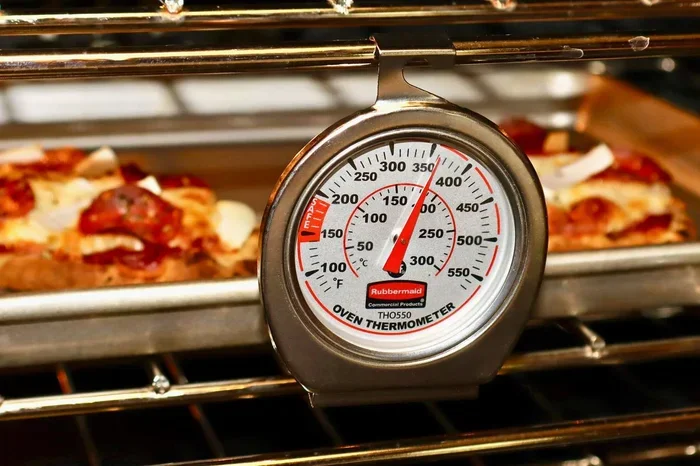
Analog thermometers are the classic choice. They use a dial face with a needle that moves to show the temperature. These are usually made of metal and glass, and they hang from the oven rack or sit on a baking sheet. They are affordable, durable, and do not need batteries. Many home cooks love them because they are simple and reliable.
One thing to keep in mind with an analog thermometer is that the reading can take a minute or two to stabilize. You need to give it time to adjust to the oven’s heat. Also, the dial face can sometimes be hard to read through the oven window, especially if your oven light is dim.
Digital Oven Thermometers
Digital thermometers offer a more precise reading with an easy-to-read LCD screen. Many models come with a probe that you can leave inside the oven while it preheats. The digital display gives you a fast and clear temperature reading. Some advanced models even have alarms that go off when your target temperature is reached.
The main advantage of a digital thermometer is speed and accuracy. You get a reading in seconds, and the display is easy to read from a distance. The downside is that they need batteries, and the electronic parts can sometimes fail if exposed to too much moisture or extreme heat over time.
Probe Thermometers for Oven Use
A probe thermometer is a type of digital thermometer designed to stay in food while it cooks. You insert the probe into the meat or dish, and the wire runs out through the oven door to a digital readout outside. This is incredibly useful for roasting because you can monitor the internal temperature of your food without opening the oven door.
Probe thermometers are excellent for tracking meat thermometer readings and ensuring your roasts reach the right food safety temperature. However, they measure the temperature of the food, not the air inside the oven. So if you want to test your oven’s heat, you need a separate oven thermometer.
Comparison: Analog vs. Digital Oven Thermometers
| Feature | Analog Thermometer | Digital Thermometer |
|---|---|---|
| Price Range | $5 – $15 | $10 – $30 |
| Accuracy | Good, ±5°F | Excellent, ±1°F |
| Reading Speed | 1-2 minutes | Instant |
| Battery Required | No | Yes |
| Durability | Very high | Moderate |
| Ease of Reading | Moderate | Very easy |
| Best For | Basic oven testing | Precision baking and roasting |
For most home cooks, either type works well. If you want simplicity and low cost, go with an analog thermometer. If you want precision and convenience, a digital model is the better choice. Some cooks even keep both in their kitchen for different purposes.
How to Place Your Oven Thermometer Correctly
Buying a good thermometer is only half the battle. Where you place it inside the oven makes a huge difference in the accuracy of your reading. Oven thermometer placement is one of the most overlooked parts of measuring oven temperature, and getting it wrong can lead to misleading results.
Best Locations Inside the Oven
The center of the oven is the best spot for most thermometers. Place it on the middle rack, ideally in the back center area. This position gives you the most representative reading of the overall oven temperature because it is away from the heating elements and the door, both of which can create temperature variations.
If you use a hanging analog thermometer, clip it to the middle rack so the dial faces the oven door. This way, you can read it easily without opening the door and losing heat. For a digital probe thermometer, place the probe in the center of the oven cavity on the middle rack.
Here are some placement tips to keep in mind:
- Always use the middle rack. This is where heat is most evenly distributed.
- Face the dial toward the door if using an analog thermometer.
- Keep the thermometer away from the walls. Oven walls can be hotter or cooler than the center air.
- Do not place it directly above or below a heating element. This gives a false high or low reading.
- Keep it away from the oven door seal. Heat escapes here, creating a cold zone.
Where Not to Place Your Thermometer
There are a few spots inside the oven that will give you inaccurate readings. Avoid placing your thermometer on the top or bottom rack near the heating elements. The top element radiates direct heat downward, which makes the area directly below it much hotter than the rest of the oven. The bottom element can create a hot zone right above it as well.
Also avoid placing the thermometer right next to the oven door. Every time you open the door, heat escapes, and the temperature near the door drops significantly. This area is especially prone to temperature fluctuations and does not represent the true oven temperature of the cavity.
Another mistake is placing the thermometer on the oven floor. The floor can be much hotter than the center, especially in ovens with a bottom heating element. This gives you a reading that is higher than the actual average temperature inside the oven.
Step-by-Step: Testing and Calibrating Your Oven
Now that you know which thermometer to use and where to place it, let us walk through the actual process of testing and calibrating your oven. This process is straightforward and takes about 20 to 30 minutes.
Testing Oven Temperature Accuracy
Start by placing your oven thermometer on the middle rack, in the center of the oven. Close the door and set your oven to 350°F. Do not open the door during this test. Wait at least 20 minutes for the oven to fully preheat and stabilize.
After 20 minutes, check the thermometer reading. Compare it to the temperature you set on the temperature dial. If the thermometer reads 350°F, your oven is accurate. If it reads 375°F, your oven is running 25 degrees hot. If it reads 325°F, your oven is running 25 degrees cold. Either way, now you know the truth about your oven’s actual oven temperature.
For the most reliable results, repeat the test at two other temperatures: 250°F and 425°F. Some ovens have calibration issues that only show up at certain temperature ranges. Testing at multiple points gives you a fuller picture of your oven’s behavior.
How to Calibrate an Analog Thermometer
If your analog thermometer is reading incorrectly, you can often calibrate it yourself. Most analog thermometers have a small calibration nut on the back or underneath the dial face. Use a pair of pliers or a wrench to gently turn this nut.
First, test the thermometer in boiling water. Boiling water should read 212°F at sea level. If your thermometer reads differently, turn the calibration nut until the needle points to the correct temperature. This adjusts the baseline so your thermometer reads accurately going forward.
Keep in mind that boiling point changes with altitude. If you live at a high elevation, water boils at a lower temperature. Check a boiling point calculator for your elevation to get the correct reference temperature.
How to Calibrate a Digital Thermometer
Digital thermometers are a bit different. Many models have a calibration function built into the settings menu. Check your user manual for specific instructions. Most digital thermometers can be adjusted by entering a calibration mode and inputting the correct offset.
If your digital thermometer does not have a calibration feature, you can still use it accurately. Simply note the difference between what it reads and the actual temperature, and adjust your oven setting accordingly. For example, if your thermometer reads 25°F lower than the set temperature, set your oven 25°F higher than what the recipe calls for.
Some modern ovens have a built-in oven sensor that can be calibrated through the oven’s control panel. Check your oven’s manual for calibration instructions specific to your model. This is especially common in convection ovens and higher-end ranges.
Common Oven Temperature Problems and Solutions
Even with a thermometer, you may run into issues with your oven’s heat. Understanding these common problems helps you troubleshoot and fix them quickly.
Hot Spots and Cold Zones
Oven hot spots are areas inside the oven that are significantly hotter or cooler than the rest. They happen because heat does not always distribute evenly. Hot spots are one of the most common reasons for uneven baking results.
You can map out the hot spots in your oven with a simple test. Place your oven thermometer on different spots across the middle rack and note the temperature at each location. You will likely see a difference of 20 to 50 degrees between the hottest and coolest spots. Once you know where your hot spots are, you can adjust your cooking accordingly.
Here is how to deal with hot spots:
- Rotate your pans halfway through cooking to expose all sides to even heat.
- Use a baking stone or pizza stone on the lower rack. It absorbs and radiates heat more evenly.
- Avoid overcrowding the oven. Too many pans block airflow and create more uneven zones.
- Use the convection setting if your oven has one. The fan helps distribute heat more evenly across the cavity.
Oven Running Too Hot or Too Cold
If your oven consistently runs hot or cold, the oven thermostat may need replacement. A thermostat that is stuck or worn out cannot regulate heat properly. In most cases, this is an easy and affordable repair that a technician can handle.
In the meantime, you can compensate by adjusting your oven setting. If your oven runs 25°F hot, set the dial 25°F lower than the recipe recommends. If it runs cold, set it higher. Just make sure you know the offset by testing with your oven thermometer first.
Temperature Fluctuations
It is normal for oven temperature to fluctuate slightly during cooking. The thermostat cycles the heating element on and off to maintain the set temperature. This creates a natural swing of about 10 to 15 degrees. However, if the fluctuations are larger than 25 degrees, there may be an issue with the thermostat or the oven door seal.
A worn door seal lets heat escape, causing the oven to work harder and temperature to swing wildly. Check your door seal for cracks, gaps, or damage. If it looks worn, replacing it is a simple and inexpensive fix that can significantly improve your oven’s temperature accuracy.
Tips for Consistent Baking and Cooking Results
Once you know how to measure oven temperature accurately, you can take your cooking to the next level. Here are some practical tips that help you get the best results every time.
Quick Tips for Better Results
- Always preheat your oven. Give it at least 15 to 20 minutes to reach the target temperature before putting food inside.
- Use a thermometer every time. Do not rely on the oven dial alone. Even new ovens can be off.
- Invest in a good-quality thermometer. A reliable thermometer pays for itself in saved ingredients and better results.
- Know your oven’s quirks. Every oven is different. Spend time learning yours, and you will cook better.
- Use an oven light and window to check on food without opening the door and losing heat.
- Let your thermometer settle. Give it at least 60 seconds to adjust to the oven temperature before reading it.
Common Mistakes to Avoid
There are a few mistakes that even experienced cooks make when it comes to oven temperature. Avoiding these simple errors can make a big difference.
Opening the oven door too often. Every time you open the door, the temperature drops by 25 to 50 degrees. It takes several minutes for the oven to recover. Try to resist the urge to peek too much, especially during the first half of baking time.
Ignoring the thermometer reading. Some people buy an oven thermometer and then forget to check it. The whole point is to use it. Make it a habit to glance at the thermometer before and during cooking.
Assuming all racks are the same. The top rack is usually hotter because heat rises. The bottom rack is closer to the bottom element and can be much hotter as well. The middle rack offers the most even heat distribution for most cooking tasks.
Not recalibrating after a move. If you recently moved your oven or rearranged your kitchen, the thermostat may have shifted. It is a good idea to recheck your oven temperature after any move or major installation.
Final Thoughts on How To Measure Oven Temperature
Measuring oven temperature with a thermometer is one of the simplest and most impactful upgrades you can make in your kitchen. It costs almost nothing, takes just a few minutes, and transforms the way you cook. Whether you are baking a delicate soufflé, roasting a Sunday roast, or making a batch of cookies, knowing your true oven temperature gives you confidence and consistency.
Do not let a faulty dial or a guessing game ruin your favorite recipes. Pick up an oven thermometer today, place it correctly, and test your oven’s accuracy. Once you see the real numbers, you will wonder how you ever cooked without one. The difference in your baking results will speak for itself.
Make it a habit to check your oven temperature regularly. Ovens drift over time, and what was accurate last month might be off today. A quick five-minute test before your next bake can save you from a failed dish and wasted ingredients. Trust your thermometer, trust your cooking, and enjoy the results that come with knowing exactly what is happening inside your oven.
Frequently Asked Questions
Can I use a meat thermometer to measure oven temperature?
A meat thermometer is designed to measure the internal temperature of food, not the air temperature inside the oven. While some meat thermometers can handle high oven temperatures, they are not the best tool for testing oven accuracy. Use a dedicated oven thermometer for measuring the heat inside your oven cavity.
How often should I calibrate my oven thermometer?
You should test your oven thermometer every few months, especially if you bake frequently. Analog thermometers can drift over time due to repeated exposure to high heat. Digital thermometers are more stable but should still be checked periodically. A quick boiling water test can confirm whether your thermometer is still reading accurately.
Why does my oven show the right temperature but food cooks differently?
This is often caused by oven hot spots or uneven heat distribution. The oven sensor might read correctly at one point, but other areas of the oven could be significantly hotter or cooler. Using a separate oven thermometer and mapping out the temperature at different rack positions helps you identify these problem areas.
Is a convection oven more accurate than a regular oven?
A convection oven uses a fan to circulate hot air, which promotes more even heat distribution. This often results in more consistent cooking, but the convection fan can also affect how a thermometer reads. For the most accurate test, use the conventional bake setting and place your thermometer in the center of the middle rack.
What temperature should my oven actually be at 350°F?
Your oven should read as close to 350°F as possible when set to that temperature. A variance of plus or minus 10 to 15 degrees is normal for most ovens. If your oven temperature is off by more than 25 degrees, consider calibrating your oven or having the thermostat checked by a professional.
Do I need to buy an expensive oven thermometer?
No, you do not need an expensive thermometer to get accurate results. A basic analog oven thermometer costs between $5 and $15 and provides reliable readings. If you prefer more precision and convenience, a digital model in the $15 to $30 range is a great investment. The key is to use whatever thermometer you have consistently and trust the readings it gives you.